When your CNC rotary table experiences vibration, positioning errors, or excessive deformation under load, the bearing assembly can directly affect machining accuracy. A large diameter slewing bearing must provide sufficient load capacity and structural rigidity, especially when equipment handles axial forces, radial forces, and tilting moments simultaneously. However, not every bearing design meets the requirements of precision rotary applications.
Shenzhen Xinchangsheng Bearing Co., LTD. (XCCZC Bearing) manufactures precision bearings for automation, automotive, medical, and energy applications. Its YRT series turntable bearings combine axial and radial roller arrangements to support demanding rotary positioning tasks. With available inner diameters ranging from 50 mm to 850 mm across the specified series, these bearings offer options for different machine designs. Understanding their construction, precision grades, and mounting requirements helps you select a suitable solution for your equipment.
What Is a Large Diameter Slewing Bearing?
A large diameter slewing bearing supports rotational movement while carrying loads transferred between connected machine structures. In precision equipment, engineers must consider more than bearing diameter. They also need to evaluate stiffness, runout, load direction, mounting accuracy, and operating speed.
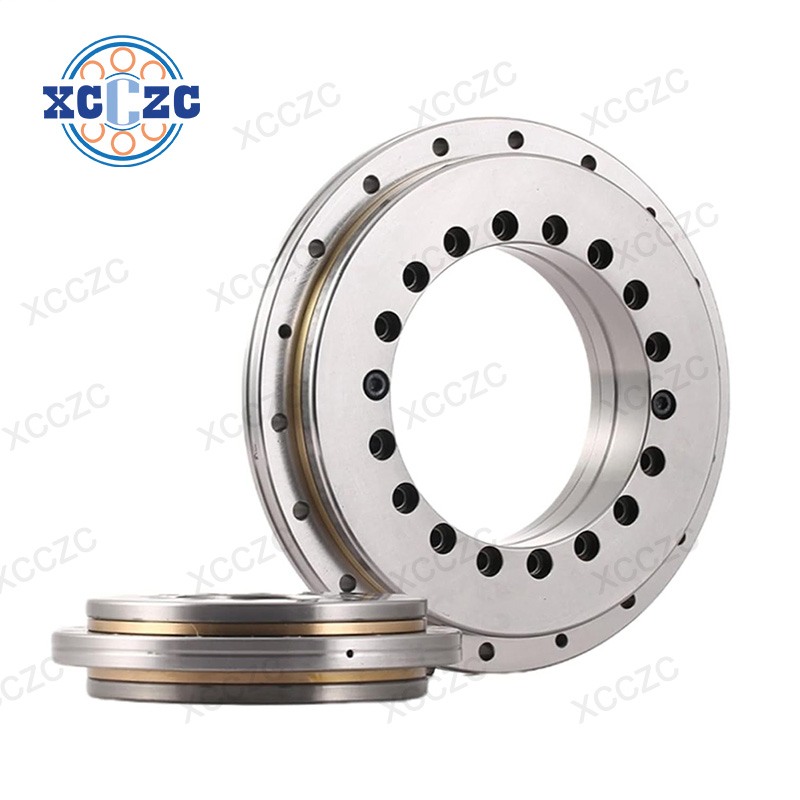
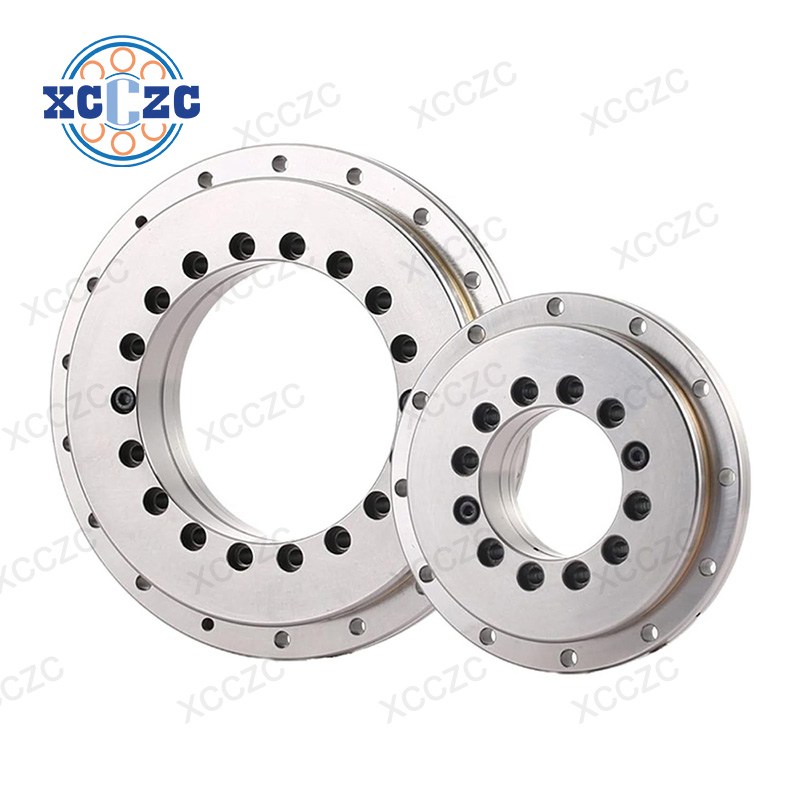
The YRT series is designed specifically for precision rotary tables and similar applications. Its three-row roller arrangement separates axial and radial load support.
How YRT Turntable Bearings Work
The YRT design incorporates three roller rows:
- Two axial roller rows: Support axial loads acting in opposite directions.
- One radial roller row: Accommodates radial forces acting perpendicular to the bearing axis.
- Preloaded rolling elements: Help reduce internal clearance and elastic displacement under operating loads.
This arrangement makes YRT bearings suitable for rotary tables that require stable positioning during milling, grinding, indexing, and inspection.
However, YRT turntable bearings are not interchangeable with every conventional slewing ring. You should confirm the required load capacity, mounting dimensions, rotational speed, and precision specifications before selecting a model.
Key Specifications for YRT Precision Bearings
When evaluating a high precision bearing manufacturer, compare documented specifications against your equipment requirements rather than relying on product names alone.
| Specification |
YRT Series Information |
Selection Consideration |
| Inner diameter |
50–850 mm across the specified range |
Match the shaft or central opening |
| Outer diameter |
80–1,090 mm across the specified range |
Check available installation space |
| Height |
20–96 mm, depending on size |
Verify axial installation clearance |
| Precision grades |
P4 and P2 options, subject to model availability |
Match the required positioning accuracy |
| Material |
GCr15 bearing steel or case-hardened steel, depending on design |
Confirm material and heat-treatment specifications |
| Mounting |
Through-holes on inner and outer rings |
Check bolt patterns and mounting surfaces |
| Lubrication |
Grease lubrication; special lubrication provisions may be available |
Follow the selected model’s maintenance requirements |
These figures describe the supplied series information, not a guarantee that every model supports the entire dimensional range. Before ordering, request the dimensional drawing and model-specific technical data.
Where Large Diameter Slewing Bearings Are Used
YRT precision rotary bearings support equipment that needs controlled rotation and resistance to combined loads.
CNC Rotary Tables and Machining Centers
During milling or grinding, cutting forces can create tilting moments that affect tool-to-workpiece positioning. A properly selected YRT bearing helps maintain rotary-table stiffness and repeatability. Engineers should verify permissible loads, runout, preload, and mounting accuracy for the actual operating conditions.
Measurement and Medical Equipment
Coordinate measuring machines, optical inspection turntables, and certain medical imaging assemblies require controlled rotation. In these applications, bearing selection must account for runout, smooth movement, noise, and the equipment’s full operating range.
Robotics and Antenna Positioning
Robotic rotary axes and antenna positioning systems may experience changing loads and repeated indexing cycles. The bearing must match the required moment stiffness, rotational speed, environmental conditions, and service requirements.

YRT Bearings vs. Conventional Bearing Designs
Choosing the right bearing architecture helps you avoid unnecessary redesign and performance problems.
| Feature |
YRT Turntable Bearing |
Conventional Deep Groove Ball Bearing |
Crossed Roller Bearing |
| Axial load support |
Designed for bidirectional axial loads |
Depends on configuration and limitations |
Depends on model and arrangement |
| Radial load support |
Dedicated radial roller row |
Supported within its rated limits |
Supported by crossed roller arrangement |
| Tilting moment resistance |
Designed for combined-load rotary applications |
Often requires additional bearing arrangements |
Can provide high rigidity, depending on design |
| Typical application |
Precision rotary tables |
General-purpose rotating machinery |
Precision rotary axes and compact stages |
| Selection priority |
Combined loads and rotary-table stiffness |
General radial and moderate axial loading |
Compact precision support and combined loading |
No design is universally superior. Your choice should depend on load calculations, installation geometry, accuracy requirements, speed, and total system cost.
How to Select the Right YRT Bearing
Follow these steps when specifying a large diameter precision rotary bearing.
- Define the operating loads. Calculate axial and radial forces, tilting moments, and load variations throughout the operating cycle.
- Confirm the required dimensions. Check the inner diameter, outer diameter, height, bolt-hole arrangement, and available mounting space.
- Set the precision target. Determine acceptable axial and radial runout, positioning repeatability, and stiffness. Confirm the actual values available for your chosen model.
- Review operating conditions. Specify speed, temperature, lubrication, contamination exposure, and expected duty cycle.
- Request technical confirmation. Ask XCCZC Bearing for model drawings, load ratings, precision documentation, and mounting recommendations before finalizing the design.
This process helps you compare suitable models and reduces the risk of selecting a bearing based on dimensions alone.
Why Consider XCCZC Bearing?
Founded in 2002, Shenzhen Xinchangsheng Bearing Co., LTD. focuses on precision bearing manufacturing and serves customers across multiple industrial sectors. Its stated capabilities include customized bearing designs, OEM services, engineering support, and quality inspection.
When evaluating a supplier, ask for evidence relevant to your application, including:
- Model-specific dimensional drawings and load ratings.
- Available precision-grade and runout inspection records.
- Material and heat-treatment information.
- Quality management certifications applicable to the manufacturing facility.
- Sample availability, production lead time, and export documentation.
These records allow you to assess product suitability and supplier capability using verifiable information.
FAQ
1. Is a YRT bearing suitable for a large diameter rotary table?
Yes, provided the selected model meets the table’s dimensions, axial and radial loads, tilting moment, speed, and accuracy requirements. Confirm the specific model’s technical limits before installation.
2. What is the difference between P4 and P2 precision grades?
P2 generally represents a tighter precision class than P4 under applicable bearing precision standards. However, the exact tolerances depend on the relevant standard and bearing type. Request the manufacturer’s dimensional and running-accuracy specifications for direct comparison.
3. Can XCCZC Bearing provide customized bearing solutions?
XCCZC Bearing states that it provides OEM services and customized bearing solutions. You can submit your required dimensions, load conditions, precision targets, and application details to confirm whether a suitable configuration is available.
Conclusion
Selecting a large diameter slewing bearing requires careful evaluation of load capacity, rigidity, precision, mounting dimensions, and operating conditions. For CNC rotary tables, machining centers, robotics, and measurement equipment, YRT turntable bearings offer a three-row roller arrangement designed to support combined loads and precise rotary movement. By comparing model-specific specifications and working with an experienced high precision bearing manufacturer such as XCCZC Bearing, you can make a more informed decision for your equipment.
CTA
Contact XCCZC Bearing at manager@xcs-bearing.com or call +86-15218715881 to discuss your YRT bearing requirements. Provide your target dimensions, load conditions, rotational speed, and precision grade to request suitable model recommendations and technical drawings.


 by XCCZC