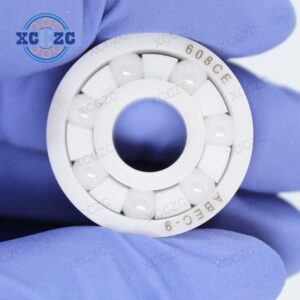
When shaft deflection, housing inaccuracies, or installation errors affect equipment reliability, choosing the right Self-aligning Bearing can reduce unnecessary stress and premature bearing failure. The 1206 self-aligning ball bearing from Shenzhen Xinchangsheng Bearing Co., Ltd. (XCCZC Bearing) uses a double-row ball design and spherical outer-ring raceway to accommodate alignment deviations during operation.
For buyers comparing bearing specifications, suppliers, or OEM options, the 1206 provides a practical combination of dimensional accuracy, load capacity, operating speed, and misalignment compensation. This guide explains its specifications, operating advantages, application scenarios, and purchasing considerations.
1206 Self-Aligning Bearing Specifications
The 1206 is a standard-size double-row self-aligning ball bearing designed for applications where maintaining perfect shaft and housing alignment can be difficult.
Specification
1206 Self-Aligning Ball Bearing
Bore Diameter (d)
30 mm
Outer Diameter (D)
62 mm
Width (B)
16 mm
Dynamic Load Rating (Cr)
Approx. 19.5 kN
Static Load Rating (Cor)
Approx. 6.55 kN
Grease Limiting Speed
Up to 9,000 rpm*
Material
High-carbon chrome steel
Hardness
58–62 HRC
Design
Double-row, spherical outer raceway
*Actual limiting speed depends on lubrication, temperature, load, clearance, sealing, and operating conditions.
This dimensional configuration makes the 1206 self-aligning ball bearing suitable for equipment designers who need a compact bearing while allowing the bearing to accommodate certain shaft or housing alignment deviations.
Why Choose a 1206 Double Row Self-Aligning Bearing?
The main advantage of this bearing design is its ability to accommodate misalignment. Instead of forcing the shaft and housing to maintain perfect alignment throughout operation, the spherical outer-ring raceway allows the bearing to adjust its internal position.
This can be particularly useful when equipment experiences shaft deflection, mounting tolerances, thermal expansion, or housing inaccuracies.
Key Performance Benefits
Misalignment compensation: Helps accommodate angular alignment deviations caused by shaft deflection or installation errors.
Double-row ball design: Provides stable radial load support for suitable industrial applications.
Reduced vibration and wear: Better alignment can reduce unnecessary stress on rolling elements and adjacent components.
Durable material: High-carbon chrome steel with a reported hardness of 58–62 HRC supports wear resistance.
High-speed capability: Grease limiting speed can reach approximately 9,000 rpm under suitable operating conditions.
OEM flexibility: XCCZC Bearing provides customized bearing sizes, logos, and packaging for different customer requirements.
Self-Aligning Bearing vs. Other Bearing Types
Selecting a bearing based only on load rating can lead to problems. You should also consider whether the equipment can maintain shaft and housing alignment during installation and operation.
Bearing Type
Misalignment Compensation
Typical Strength
Suitable Application
Self-aligning ball bearing
High
Moderate radial load capability
Shafts with alignment deviations
Deep groove ball bearing
Limited
Radial and light axial loads
General machinery
Cylindrical roller bearing
Limited
High radial load
Heavy radial loading
Angular contact ball bearing
Limited
Combined radial/axial loads
Precision rotating systems
If your equipment regularly experiences shaft deflection or mounting inaccuracies, a self-aligning bearing may provide a more appropriate solution than a conventional fixed-alignment bearing.
Where Can You Use a 1206 Self-Aligning Ball Bearing?
You can consider the 1206 for machinery where alignment cannot always remain perfectly controlled.
Agricultural Machinery
Tractors, harvesters, irrigation equipment, and other agricultural machines may experience uneven loading and shaft movement. A self-aligning design can help accommodate these operating conditions.
Conveyors and Material Handling
Conveyor systems, pulley assemblies, and roller supports can experience mounting tolerances and shaft deflection. The 1206 can support smooth rotation where moderate radial loads are present.
Textile and Manufacturing Equipment
Textile machinery often requires continuous rotation and stable operation. The self-aligning design can help reduce the effects of minor alignment errors in suitable equipment.
HVAC and Ventilation Systems
Fans and blowers can experience housing movement and thermal expansion. A suitable self-aligning bearing can help maintain reliable rotation under these changing conditions.
How to Select the Right 1206 Bearing
Before placing an order, you can evaluate the bearing through these five steps:
Confirm dimensions: Check that the 30 mm bore, 62 mm outer diameter, and 16 mm width match your shaft and housing.
Evaluate loading: Compare your actual radial and axial loads with the bearing’s approximately 19.5 kN dynamic and 6.55 kN static load ratings.
Check operating speed: Compare your working speed with the approximately 9,000 rpm grease limiting speed.
Confirm supplier capability: Ask about material, inspection, customization, packaging, lead time, and technical support before purchasing.
This process helps you avoid selecting a bearing based solely on its model number.
Why Source from XCCZC Bearing?
Shenzhen Xinchangsheng Bearing Co., Ltd. was founded in 2002 and specializes in precision bearing manufacturing. The company operates a 5,000 m² modern factory with a stated monthly output of approximately 3 million bearings and has supplied customers in more than 20 countries.
XCCZC Bearing supports OEM requirements, including customized bearing sizes, logos, and packaging. Its quality-control process includes inspection before shipment, while its engineering team provides technical support for different industrial applications.
The company also provides documented certificates and quality-related materials for customer evaluation. When you are qualifying a supplier, you should request the applicable certificate documents, inspection records, product drawings, and material information for your specific order rather than relying on generic supplier claims.
FAQ
1. What are the dimensions of a 1206 bearing?
The 1206 bearing has a 30 mm bore diameter, 62 mm outer diameter, and 16 mm width. Always verify the required mounting dimensions against your equipment drawing before ordering.
2. What is a 1206 self-aligning bearing used for?
It is commonly considered for agricultural machinery, conveyors, textile equipment, ventilation systems, and general industrial machinery where shaft deflection or mounting misalignment may occur.
3. Can XCCZC Bearing provide OEM self-aligning bearings?
Yes. XCCZC Bearing states that it provides OEM services including customized bearing sizes, logos, and packaging. For non-standard requirements, you should provide your application conditions and technical drawings for evaluation.
Conclusion
If your equipment experiences shaft deflection, housing inaccuracies, or installation errors, the Self-aligning Bearing design can help accommodate alignment deviations while maintaining reliable rotation. The 1206 combines a 30 mm bore, 62 mm outer diameter, 16 mm width, approximately 19.5 kN dynamic load rating, and double-row construction for suitable industrial applications.
For buyers comparing a 1206 self-aligning ball bearing, contact XCCZC Bearing with your shaft size, operating speed, load, lubrication method, application, and required quantity. This information allows the engineering team to confirm suitability and discuss OEM specifications, inspection requirements, packaging, and delivery options before you place an order.
🌐 I. Industry Insights — Growing Demand Amid Automation 📈 Intelligent Manufacturing Unlocks a Trillion-Yuan MarketAs global industrial automation continues to advance, the precision bearing...
In the demanding world of industrial machinery, the difference between peak performance and costly downtime often rests on a single component: the bearing. Since 2002,...



 by XCCZC